draw nfas as trees tool
Background
An NFA is typically described using a directed graph. Each edge and vertex is labeled either 0 or 1 representing possible transitions. Vertices represent the states of the NFA. Those labeled 0 are non accepting states, and those labeled 1 are accepting states.
- It takes an input string of finite length. Typically, the input string is a binary sequence of 0's and 1's.
- We begin with vertex 1 which is always the start state and follow the edges sequentially given by the bits of an input string until the input string has no further bit.
- The term 'non deterministic' means that at any state V we have more than one choice of following an edge. The NFA consumes the input string and the set of states Q represents the possible moves of NFA.
- If Q contains at least one state where the last vertex is accepting then we say that the NFA has accepted the input string otherwise the NFA has rejected the input string.
- Every NFA is not DFA, but each NFA can be translated into DFA.
Example of NFA:
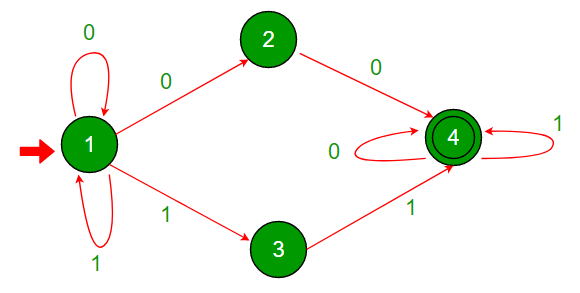
Starting state - vertex 1 Accepting states - Vertices with double circles(label 1) // Vertex 4 Non accepting states - single circles (label 0). // Vertices 1, 2 and 3.
How to check for acceptance of a string?
For Input : 1010
- In-state 1, we have two possibilities, either follow the self-loop and stay in state 1 or follow the edge labeled 1 and go to state 3.
{1} 1010 --> {1, 3} 010 - In-state 3, there is no edge labeled 0, so the computation will die out.
- In-state 1, we have two possibilities, either follow the self-loop and stay in state 1, or follow the edge labeled 0 to state 2.
{1, 3} 010 --> {1, 2} 10 - Now there is no edge labeled 1 from state 2. The computation will die out. We have two possibilities: either follow the self-loop to state 1 or follow the edge labeled 1 to state 3.
{1, 2} 10 --> {1, 3} 0 - In-state 3, there is no edge labeled 0. So the computation will die out. In-state 1, we have two possibilities: either follow the self-loop to state 1 or the edge labeled 0 to state 2.
{1, 3} 0 --> {1, 2} - Now the NFA has consumed the input. It can be either be in states 1 or 2, both of which are non accepting. So the NFA has rejected the input 1010.
For Input: 1100
{1} 1100 --> {1, 3} 100 {1, 3} 100 --> {1, 3, 4} 00 {1, 3, 4} 00--> {1, 2, 4} 0 {1, 2, 4} 0--> {1, 2, 4} - Now the NFA has consumed the input. It can either be in states 1, 2, or 4. State 4 is an accepting state. So, the NFA accepts the string 1100.
- We can easily verify that the given NFA accepts all binary strings with "00" and/or "11" as a substring.
C Program to simulate Nondeterministic Finite Automata (NFA)
Input Format: The adjacency list representation of the NFA is in the following format.
The given example will be represented as
Total Number of Edges: 4
Edge Connectivity:
1 0 4 0 1 0 2 1 1 1 3
2 0 1 0 4
3 0 1 1 4
4 1 2 0 4 1 4
Output Format: The first 10 binary strings which are accepted by the NFA in lexicographical order (e denotes the empty string): {e, 0, 1, 00, 01, 10, 11, 000, …}
The sample output for the given test case is as follows:
00
11
000
001
011
100
110
111
C
#include <stdio.h>
#include <stdlib.h>
#include <string.h>
#include <stdbool.h>
#include <math.h>
int row = 0;
struct node
{
int data;
struct node* next;
char edgetype;
} typedef node;
node* push(node* first , char edgetype , int data)
{
node* new_node = (node*) malloc ( sizeof (node));
new_node->edgetype = edgetype;
new_node->data = data;
new_node->next = NULL;
if (first==NULL)
{
first = new_node;
return new_node;
}
first->next = push(first->next,edgetype,data);
return first;
}
int nfa(node** graph, int current, char * input,
int * accept, int start)
{
if (start==( int ) strlen (input))
return accept[current];
node* temp = graph[current];
while (temp != NULL)
{
if (input[start]==temp->edgetype)
if (nfa(graph,temp->data,input,accept,start+1==1))
return 1;
temp=temp->next;
}
return 0;
}
void generate( char ** arr, int size, char *a)
{
if (size==0)
{
strcpy (arr[row], a);
row++;
return ;
}
char b0[20] = { '\0' };
char b1[20] = { '\0' };
b0[0] = '0' ;
b1[0] = '1' ;
generate(( char **)arr, size-1, strcat (b0,a));
generate(( char **)arr, size-1, strcat (b1,a));
return ;
}
int main()
{
int n;
int i, j;
scanf ( "%d" , &n);
node* graph[n+1];
for (i=0;i<n+1;i++)
graph[i]=NULL;
int accept[n+1];
for (i=0; i<n; i++)
{
int index,acc,number_nodes;
scanf ( "%d%d%d" ,&index,&acc,&number_nodes);
accept[index]=acc;
for (j=0;j<number_nodes;j++)
{
int node_add;
int edge;
scanf ( "%d%d" ,&edge,&node_add);
graph[index] = push(graph[index], '0' +edge,node_add);
}
}
int size = 1;
int count = 0;
if (accept[1]==1)
{
printf ( "e\n" );
count++;
}
while (count < 11)
{
char ** arr;
int power = pow (2,size);
arr = ( char **) malloc (power* sizeof ( char *));
for (i=0;i<power;i++)
arr[i] = ( char *) malloc (size* sizeof ( char ));
char a[20] = { '\0' };
generate(( char **)arr,size,a);
for (i=0; i<power; i++)
{
char input[20] = { '\0' };
for (j=0; j<size; j++)
{
char foo[2];
foo[0] = arr[i][size-1-j];
foo[1] = '\0' ;
strcat (input,foo);
}
int result = nfa(graph,1,input,accept,0);
if (result==1)
{
printf ( "%s\n" ,input);
count++;
}
if (count==10)
return 0;
}
size++;
row=0;
}
return 0;
}
Input:
4 1 0 4 0 1 0 2 1 1 1 3 2 0 1 0 4 3 0 1 1 4 4 1 2 0 4 1 4
Output:
00 11 000 001 011 100 110 111 0000 0001
This article is contributed by Arjun Moolrajani. Please write comments if you find anything incorrect, or you want to share more information about the topic discussed above
polkcorsoodualf39.blogspot.com
Source: https://www.geeksforgeeks.org/c-program-to-simulate-nondeterministic-finite-automata-nfa/
0 Response to "draw nfas as trees tool"
Post a Comment